

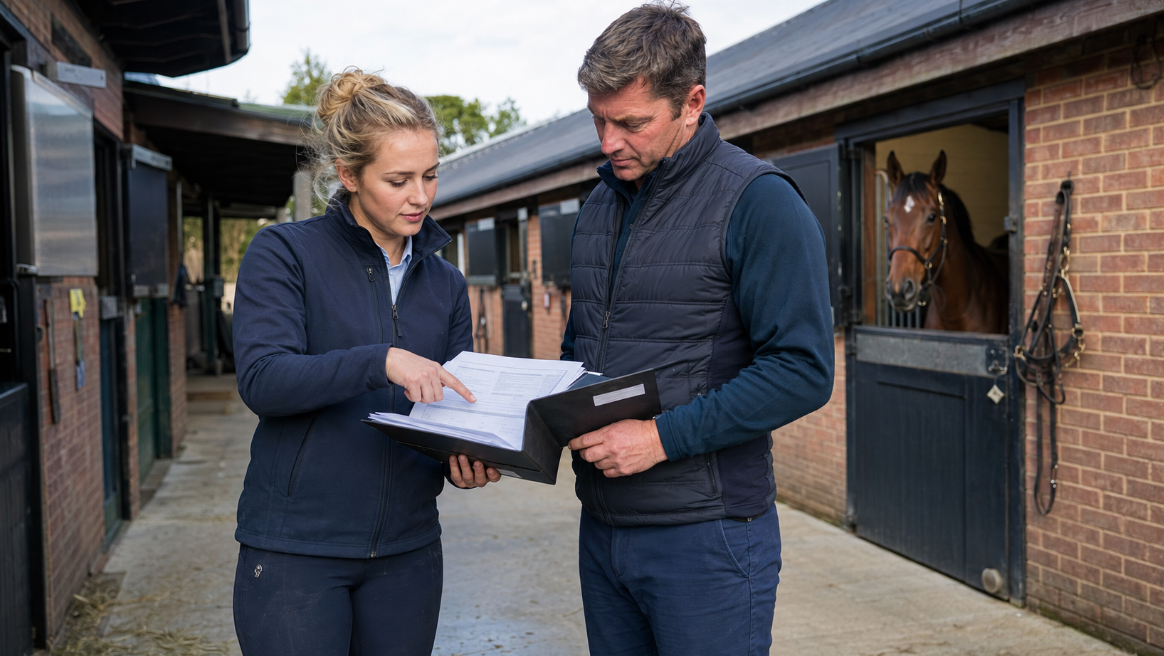
Working on a horse racing yard is very different from helping on a livery yard, private yard or at a riding school. The horses are exceptionally fit, valuable and often young. Freelancers may also be expected to use public or private gallops and handle horses in a fast-paced, highly regulated environment.
If you want to specialise in freelance racing work, experience alone is not enough. You must make sure your insurance covers the actual work you intend to undertake.
Why racing yards will ask about your insurance
Licensed trainers have significant responsibilities relating to health, safety, employment and public liability. The BHA states that trainers and permit holders must have at least £2 million of public liability insurance, including cover for racehorses at recognised race meetings. Its guidance also says that self-employed work riders should be encouraged to arrange their own insurance and must be told that they are not protected by the Racing Industry Accident Benefit Scheme, commonly known as RIABS. Read the BHA Health and Safety Manual
A trainer may therefore ask a freelancer to provide an insurance certificate before allowing them to work, particularly if the role involves riding, travelling horses or using the gallops.
This is not simply paperwork. An incorrectly insured contractor could expose both the freelancer and the racing business to serious financial and legal problems.
Standard freelance groom insurance
A normal freelance groom policy may include:
- General yard duties
- Grooming and mucking out
- Turning horses out and bringing them in
- Clipping
- Exercising or schooling horses
- Public liability
- Care, Custody and Control
However, you cannot assume that every activity is automatically covered.
Some policies only cover activities declared when the insurance was purchased. The type of horses, the environment in which you work and the exact nature of the riding may affect your cover.
The fact that a policy says it covers “riding” does not necessarily confirm that it covers riding fit racehorses on public or private gallops. That must be checked directly with the insurer.
Public liability insurance
Public liability insurance can protect you if your negligence causes injury to another person or damage to their property.
Imagine a racehorse getting loose while under your control and colliding with a vehicle, damaging gallop facilities or injuring a member of the public. A resulting claim could be considerable.
Freelance groom policies offer different limits. KBIS, for example, currently offers limits of £1 million, £2 million or £5 million on its general freelance groom policy. Individual racing yards may set their own minimum requirements, so you must ask the trainer what level they expect. See KBIS Freelance Groom Insurance
Do not simply choose a figure because it sounds sufficient. Confirm that the policy covers every racing activity you will perform.
Care, Custody and Control
Care, Custody and Control cover, sometimes called custodial liability, protects you when a horse in your temporary care is injured or dies and you are found legally liable.
This matters on every equine yard, but the potential financial consequences can be particularly serious in racing, where an individual horse may be worth hundreds of thousands of pounds or into the millions.
You must check the limit per horse. A standard policy may provide only £10,000 or £15,000 for each animal. That does not mean it would cover the full value of a valuable racehorse.
Ask your insurer:
- Does the policy cover racehorses in training?
- Does it cover horses while being ridden on gallops?
- What is the maximum payment for each horse?
- Are veterinary fees covered?
- What exclusions and excesses apply?
- Is there an annual claims limit?
Personal accident and income protection
Public liability protects you against certain claims made by other people. It does not replace your lost income if you are injured.
An employed racing groom who meets the relevant conditions may be able to claim through RIABS. Racing Welfare confirms that self-employed people are not eligible for the scheme. See the RIABS eligibility information
A genuine freelancer should therefore consider personal accident insurance that covers their occupation and the racing activities they perform.
Some policies include Temporary Total Disablement benefits, which may provide a weekly payment if an accident temporarily prevents you from working. Check the waiting period, weekly benefit, maximum payment period and any exclusions carefully.
The BGA explains that its personal accident insurance can cover freelance grooms while working and riding, but it does not cover riding in a race, point-to-point or team chase. This illustrates why reading the precise policy wording matters. Read the BGA insurance guidance
Personal accident insurance is there to protect your financial position. It should never be described as a way of preventing a freelancer from bringing a legitimate claim against a yard if the yard has been negligent.
Make sure you are genuinely self-employed
Insurance is only one part of the picture. Calling someone a freelancer does not automatically make them self-employed.
Employment status depends on the real working arrangement, including who controls the work, whether the individual can send a substitute, how they are paid and whether they work for several clients.
Both the freelancer and the trainer should make sure the arrangement is genuine and properly documented.
What to ask your insurer
Before offering your services to racing yards, tell your insurer exactly what you will be doing. This should include:
- Working with Thoroughbred racehorses in training
- Riding work
- Riding on public and private gallops
- Fast exercise
- Breaking and handling young horses
- Travelling racehorses
- Working at racecourses
- Working on racing studs, if applicable
- Any teaching, clipping or house-sitting services you offer
Ask for written confirmation that these activities are covered. Do not rely solely on something said during a telephone conversation.
Mention your racing cover in your TallyHO Temps bio
If racing is an area you want to specialise in, make this clear in your TallyHO Temps profile.
You could write:
Experienced freelance racing groom and work rider. My current insurance includes Public Liability, Care, Custody and Control and Personal Accident cover. My insurer has confirmed that my declared racing-yard duties and gallops work are covered. Certificates are available for clients to inspect.
Only state this if it is completely accurate. You should also keep your documents current and update your profile whenever your cover changes.
Trainers need freelancers who can step onto the yard with the right experience, professionalism and protection already in place. Having insurance specifically confirmed for racing work will not guarantee a booking, but it can remove one of the biggest reasons a racing yard may be unable to use you.
Insurance requirements and policy terms vary. Always obtain written advice from an authorised insurance provider or broker and confirm the individual yard’s requirements before accepting a booking.
Join TallyHO Temps Today
You're invited to
TallyHO.
Want to be a TallyHO Freelancer?
